Since I did previous posts on the Batman
serials and
TV show, I thought I'd conclude this trilogy of Bat-articles with the Tim Burton-Michael Keaton Batman movies.
It took almost a dozen years to get the original movie made. Ben Melniker and Michael Uslan bought the film rights in the late 1970s. By 1983, they had an ambitious script written by Tom Mankiewicz, using
Superman The Movie as a template, and based upon the late 1970s Steve Englehart-Marshall Rogers stint in
Detective Comics, featuring Batman, Robin, Joker, Penguin, Alfred, Commissioner Gordon, Boss Thorne, Silver St. Cloud, and Joe Chill.
This script has been widely available to read on the internet for many years, so I won't go into detail about it. I will say that as far as detailed origin movies go, the Mankiewicz script is much better than the slumber inducing
Batman Begins (no jeers from the Nolan Kool-Aid drinkers, please). All it needed was to be slightly revised to include some of the better Burton-Hickson ideas I will give in detail in a moment, so that Batman wasn't such a public figure (he would give televised press conferences), and perhaps a few other tweaks (the way Batman kills Thorne in the finale with a giant thumbtack is almost laughable... Burton's reworking of the finale is much better), but otherwise it was great. Faithful to the comics, good character development, great action scenes (perhaps the best is the Penguin scene where he and his goons are wearing jet pack umbrellas, going after the Batmobile, which during the course of the scene transforms into a speed boat and a jet), epic, and fun. Fun, but also has moments being quite dark, such as the ending where Silver dies in Batman's arms. (It could be argued the Mankiewicz script was also the basis for Lee and Janet Batchler's script for
Batman Forever. Both scripts share many of the same plot points, and the Dick Grayson scenes are lifted almost verbatim from the Mankiewicz draft.)
Needless to say, pre-production stalled. Jon Peters and Peter Guber were brought in as new producers by the mid-1980s. Melniker and Uslan, while retaining an "Executive Producers" credit, had no input, creative or otherwise, on any Batman project from that point on. Guber and Peters brought in Tim Burton, who with Julie Hickson, wrote a treatment that attempted to "Burton-ize" the Mankeiwicz script, while adding the distinct flavor of the 1940s era Batman comics. The basic narrative of the Mankiewicz draft remains, but Burton and Hickson add their own touches to it. Both drafts establish a political showdown between Thomas Wayne and Rupert Thorne. The Joker in Mankiewicz's script is Rupert Thorne's hired gun, and is portrayed as a murderous stand-up comedian, while Thorne is the script's dominant villain. In the Burton-Hickson treatment, the Joker is much more insane, and answers to no one. Although initially hired by Thorne, who is more of a minor character here, to kill the Waynes (in the Mankiewicz draft, the Joker has Joe Chill be the gunman and then kills him afterwards), Joker turns on Thorne and kills him at a mayoral debate.
Burton reworks the origin sequence to resemble
Detective Comics #235, where the Wayne family attend a costume after-party following a performance of the opera
Die Fledermaus. Thomas wears a "majestic bat costume," while Martha is a "delicately shimmering fairy queen" and young Bruce is a "small whirling harlequin." The Joker, described as a 17-year-old boy with "shock-white skin, radioactive-green hair, standing on end as if permanently electrified, and red, red, lips slashed into a chin so pointed it’s like a demented exaggeration of a clown face", kills Thomas and Martha from an ice cream truck as "insipid tinkling style music" plays. Alfred vows to Bruce that "as long as I live, you will never be alone." Commissioner Gordon's role was more pivotal in this treatment, being a surrogate father figure to Bruce, and suspecting he is Batman, but doesn't confront him about it. The Batcave also derives from the 1940s comics by having the entrance be a “nearby barn located several hundred yards from the mansion which has been connected to the Batcave by an underground tunnel.”

Where the Mankiewicz script dwells on Batman taking on various street criminals, Burton focuses on The Joker's reign of terror consisting of releasing animals from the zoo, preempting TV broadcasts (he holds Barbara Walters at gunpoint as he forces her to interview him, and he preempts himself into
The Love Boat with guest stars Tom Bosley, Cloris Leachman, and Andy Warhol), painting all the windows of Gotham's skyscrapers black, making the subways run backwards, and painting the entire city candy-striped colors. Bruce saves Silver St. Cloud at one of the Joker's crime scenes and starts a romance with her. The Joker then mock-elects himself mayor after killing Thorne and Bruce starts a campaign against him, giving a televised speech for people not to lose hope and to vote against the Joker.
The Joker strikes next at a charity circus where Bruce and Silver are in attendance. There, in disguises are the Penguin as the ringmaster, the Riddler as a clown, and Catwoman "sexily decked out as a trapeze artist". Catwoman pours acid on the trapeze of the Flying Graysons ("the main attractions"), John and Mary fall to their deaths, while young Dick miraculously survives by falling into the bales of hay on the circus ground - “The effect is like a baby bird falling out of a tree into a nest.” Running to the sobbing Grayson's side, Bruce scoops him up and carries him to his car, promising him that "As long as I live, you will never be alone." Burton describes Dick as “a charmer: a clever little wise-ass with a loving heart. He’s pale-skinned to the point of ghostly, defined by an alert little face and carrot-colored hair (sort of a new-wave Artful Dodger).”
Burton uses the parade sequence with balloons filled with his deadly laughing gas that would appear in the 1989 movie. There is a confrontation between Batman and The Joker that results in both being carried off by the balloons. When they both crash through the skylight of the Gotham Museum, it's up to the new hero, Robin, “a flash of red and green” with a “devilish mask”, to save Batman's life. When Batman throttles the Joker and puts a gun to his head, Commissioner Gordon arrives, puts a hand on Batman’s shoulder and stops him from making a choice that would ruin his life (much better than the giant thumbtack scene). The treatment ends on Christmas morning as Bruce, Dick, Silver and Alfred open up presents... the last one is wrapped in purple and green and has a clownish face on it.
Not happy with the treatment, still feeling it was too much like
Superman The Movie in format if not style, Sam Hamm was brought in to write a new script based on a treatment by Steve Englehart. It was brilliant. By avoiding a chronological enactment of Batman's origin and instead starting the movie where Batman has existed for a few weeks, Hamm succeeds in not only breaking the Richard Donner mold, but presents Batman as a character shrouded in mystery. By not spelling out every little detail, the viewer gets to use their imagination to figure out how Bruce became an expert martial artist or how he came up with all the gadgets... or they could choose not to, and just enjoy the ride without being bogged down with such questions. Hamm's first draft script (also widely available to read on the internet) was superior to the final shooting script. Bruce Wayne is the center of the script, and is clearly a troubled man, highlighted by several scenes where Vicki Vale and Knox separately confront Bruce about being Batman. You want to cheer him as Batman, yet you can't help but feel sorry for him. Joker is a bit more deadly than in the final film, and Hamm includes a brilliant version of Robin that not only makes the script seem more epic, but gives the story closure.

Unfortunately, Warner Brothers wanted rewrites done, being apprehensive about the dark and troubled portrayal of Bruce, and the writers' strike prevented Hamm from doing it himself, so Warren Skarren was brought in. His one addition that would have made Hamm's script absolutely perfect was the scene where Bruce lays the roses on the spot his parents were murdered. Unfortunately, the changes didn't end there. Bruce's darkness was toned down a notch while the Joker's role was expanded and made a bit more outlandish, Vicki Vale's role was also expanded while Commissioner Gordon and Harvey Dent were both downplayed, and Robin was cut out completely, despite 13 year old Ricky Addison Reed being cast. Skarren also reintroduced the idea of the Joker killing Bruce's parents, from the Mankeiwicz and Burton-Hickson drafts. Also Skarren added more action to the climax, but in the process, made it less logical. In Hamm's draft, Joker shot the Batwing down with a tank and Robin had to rescue Batman from the wreckage, with Batman suffering a broken leg and several broken ribs. In an apparent death wish, Batman sets a time bomb in his utility belt, and grabs hold of the Joker who begins to panic, screaming "It's not funny!" Batman gets a big smile and asks, "No ... sense ...of ...humor?"

Despite the fact Hamm's draft was better than the final shooting script, the movie is still the best live action version of Batman to date, with Michael Keaton unquestionably the coolest screen Batman ever. Keaton's performance is simply magical. It's the little things that make him stand out head and shoulders above all the other actors who have played Batman. As Bruce Wayne, Keaton is brooding, reclusive, and a little scatter-brained. Watch his eyes, as Keaton is a master of silent acting. You see in his eyes the pain he suffers from watching his parents murdered. You see he is conflicted about Vicki Vale just as his crusade as Batman begins to grow. Plus, Keaton adds a sense of humor to it all. As Batman, Keaton is silent and imposing. When he snarls, "I'm Batman!", you take notice. At the right moments, he gives this little off-hinged smile that drives home the fact that Batman is dangerous. His voice as Batman is a harsh whisper that is perfect for the character, and not overdone like Christian Bale's frog voice that brings forth more giggles than intimidation.
Where as Uslan and Melniker wanted a living comic book action film, Tim Burton delivered something far more interesting and artistic and three-dimensional. By blending 1930s Warner Brothers gangster films with 1920s silent horror movies, he really brought Batman's world to life in a way no one thought possible.
The sequel went through almost as many scripts as the first film, despite it taking only three years to make. The original idea for
Batman II: The Next Adventure was proposed by Sam Hamm and reportedly featured the transformation of Harvey Dent into Two Face after failing to convict the Joker, who survived the fall at the end of
Batman. Warner Brothers felt Two Face was not a popular enough character to be the lead villain and rejected Hamm's proposal, demanding the more well known Penguin and/or Catwoman be used.

So, Hamm shelved
Batman II (apparently, the plot was recycled by William Loebs for the Batman syndicated comic strip that was circulating after the first movie) and began work on a new script titled
Batman Returns, and once again it was excellent. Set at Christmas time, the plot deals with an obese, aristocratic criminal named Mr. Boniface (alias the Penguin), who has spent the last thirteen years in jail for stealing 40 million dollars. He makes a deal to return the money for an early parole. Of course, he had it in the bank, and made millions of dollars in interest during his jail term. Penguin hires the erotic Eurasian cat burglar Selina Kyle to steal five raven statues from the founding five families of Gotham, and frame Batman for the murders.
Echoing the "Purrfect Crime" episode of the 1960s TV show, the ravens are a map that lead to a treasure. Unknown to Bruce, the map leads to where the treasure is buried--in the Batcave. Harvey Dent is no where to be found, but Gordon, Vicki, and Alfred are all back, as well as a group of wanna be teen vigilantes who hero worship Batman. At one point, Vicki is rescued by an orphaned homeless kid named Dick Grayson who seems to be quite an acrobat. Later, the kid helps Batman escape from the cops, and ultimately moves into Wayne Manor just before Penguin and Catwoman invade the place. Unfortunately, Tim Burton felt the script read too much like a sequel. Granted, the finale also seemed quite rushed and there never was any resolution with the storyline of the teen vigilantes. A second draft would be needed to correct these problems.

But Burton wanted to do "another Batman movie", not a sequel. With Denise DiNovi taking over as producer from Guber and Peters, Burton had much more creative control over the film. So the script was given to Daniel Waters to rewrite, and Sam Hamm unfortunately hasn't been involved in the franchise since. Waters kept a lot of the details in Hamm's draft, but reworked the plot from the "Purrfect Crime" style treasure hunt, to the Pengy for Mayor plot from "Hizzoner the Penguin" (also possibly recycled from the similar "Joker for mayor" plot point from the Burton-Hickson treatment). He eliminated Vicki, the teen vigilantes, and the members of Gotham's Five Families, and reduced Gordon to little more than a cameo.
There are unconfirmed rumors the original plan was to have a now corrupted Harvey Dent, whose goal was to groom mob boss Penguin into a mayor Dent could control. Selina Kyle went from being an amorous cat burglar to Dent's mousy secretary. For the planned climax, as Batman, Catwoman, Penguin and Dent collide at Pengy's zoo hideout, Dent's fate was to be sealed as an exploding air conditioner burns and scars the left side of his face. A snag in planning the script happened when Warner Brothers, who were allegedly not happy with Billy Dee Williams' performance as Harvey Dent in the first film, bought him out of his contract for the sequels. Allegedly, Warners never wanted Williams cast as Dent in the first place. It's rumored the studio's top picks were Dale Midkiff (
Pet Cemetery) and Don Johnson (Harvey Dent in
Batman The Animated Series looks strikingly like Don Johnson), but Burton cast Williams. So Waters reworked Dent's planned role in the script for retail mogul Max Shreck, with Christopher Walken ultimately landing the role. While Max did not appear in Hamm's draft, Shreck's Department Store did.
Danny DeVito had been cast as Penguin, suggested to Burton that Oswald Cobblepot be a disgusting sewer dwelling mutant. Burton loved the concept, and Waters worked in DeVito's vision of the Penguin. Waters, under Burton's suggestions, also made a drastic change to Dick Grayson. Now an African American character known only as "The Kid", he was a teenage mechanic who helps Batman repair the Batmobile and escape from the cops, and later is recruited to help stop the army of penguins. Burton liked Waters' draft much more, but rewrites were needed.

Since Waters had moved on to other projects, Wesley Strick was in charge of the rewrites. He removed some of Waters' more bizarre sequences, such as a long scene where Batman and Penguin joke and laugh with each other, a weird scene where goons dressed in Batman costumes attack people, and deleted a pair of characters named Punch and Juliet, who worked for the Penguin. He altered some of the bizarre dialogue that Waters peppered the script with, and deleted the revelation that Oswald and Max were brothers, which in the Waters' draft read like an afterthought that had no impact on the plot. Burton also ordered Strick to once again circumcise Dick, or rather, The Kid, from the script. The character, as written, was patronizing, reading like a middle aged white man's idea of what a "hip" black teen should be like, with lots of Chris Rock style outbursts. Had this come to pass, hopefully Marlon Wayans, who was initially cast as The Kid, would have been given the opportunity to rewrite his own dialogue, perhaps making the role less embarrassing.
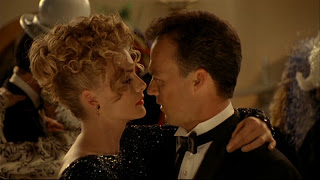
Batman Returns was a movie I did not like very much on a first viewing. But the more times I watched it, the more I liked it, finding details in the story I didn't notice the first time around. It is perhaps the most complex and layered Batman movie ever made. Anchoring the movie once again is Keaton's splendid performance building on what he established in the first film. The chemistry between Keaton and Michelle Pfeiffer is one of the highlights of the movie (apparently they were romantically involved several years earlier). Also, Batman's costume has been perfected for this movie. It's not as primitive as the 1989 film, and takes on an armored design. It is my favorite movie batsuit. Even so, I have to say Hamm's draft may have made a better movie. However, Strick's final shooting script is far superior to Waters' draft.
It is a shame Burton and Keaton never had the chance to conclude their Bat-trilogy. Perhaps there may still be an opportunity, as I think reuniting Burton, Keaton, Nicholson, Pfeiffer, and Sam Hamm to make a film adaptation of Frank Miller's
Dark Knight Returns graphic novel would be a Batman fan's dream come true.
Credit: Batman Movie Online for the details of the Burton-Hickson treatment.




 Where the Mankiewicz script dwells on Batman taking on various street criminals, Burton focuses on The Joker's reign of terror consisting of releasing animals from the zoo, preempting TV broadcasts (he holds Barbara Walters at gunpoint as he forces her to interview him, and he preempts himself into The Love Boat with guest stars Tom Bosley, Cloris Leachman, and Andy Warhol), painting all the windows of Gotham's skyscrapers black, making the subways run backwards, and painting the entire city candy-striped colors. Bruce saves Silver St. Cloud at one of the Joker's crime scenes and starts a romance with her. The Joker then mock-elects himself mayor after killing Thorne and Bruce starts a campaign against him, giving a televised speech for people not to lose hope and to vote against the Joker.


 So, Hamm shelved Batman II (apparently, the plot was recycled by William Loebs for the Batman syndicated comic strip that was circulating after the first movie) and began work on a new script titled Batman Returns, and once again it was excellent. Set at Christmas time, the plot deals with an obese, aristocratic criminal named Mr. Boniface (alias the Penguin), who has spent the last thirteen years in jail for stealing 40 million dollars. He makes a deal to return the money for an early parole. Of course, he had it in the bank, and made millions of dollars in interest during his jail term. Penguin hires the erotic Eurasian cat burglar Selina Kyle to steal five raven statues from the founding five families of Gotham, and frame Batman for the murders.


 So from the Silver Age onwards Two-Face was renamed Harvey
Dent. The second Golden Age Two-Face was Paul Sloane, an actor who
sustained a similar injury to Kent and adopted his predecessor’s modus operandi
as his own.
So from the Silver Age onwards Two-Face was renamed Harvey
Dent. The second Golden Age Two-Face was Paul Sloane, an actor who
sustained a similar injury to Kent and adopted his predecessor’s modus operandi
as his own.


 In the film, Two-Face tries to kill Batman by crashing the helicopter
into a statue bearing an uncanny resemblance to New York City’s Statue of
Liberty. The Gotham City of the comics has been shown to have a similar landmark
called ‘The Statue of Freedom’, as seen here in ‘Into the Den of the
Death-Dealers!’ (Detective Comics #411, May 1971
In the film, Two-Face tries to kill Batman by crashing the helicopter
into a statue bearing an uncanny resemblance to New York City’s Statue of
Liberty. The Gotham City of the comics has been shown to have a similar landmark
called ‘The Statue of Freedom’, as seen here in ‘Into the Den of the
Death-Dealers!’ (Detective Comics #411, May 1971 Two-Face's parachute is marked with a red and black yin-yang symbol.
This is more or less identical to the emblem on the side of Two-Face's dirigible
in Matt Wagner's Batman: Faces (1992).
Two-Face's parachute is marked with a red and black yin-yang symbol.
This is more or less identical to the emblem on the side of Two-Face's dirigible
in Matt Wagner's Batman: Faces (1992).


 We also hear him say "Riddle me this..." for the first time in this
scene. The Riddler in the comics often says this before proposing his latest
conundrum.
We also hear him say "Riddle me this..." for the first time in this
scene. The Riddler in the comics often says this before proposing his latest
conundrum.


 Back at Nygma’s apartment, he tries to concoct an appropriate
costumed identity for himself. In doing so he considers several different
monikers under which he might operate. These include the Puzzler, the Gamester,
Captain Kill and Question Mark Man. Some of these are pre-existing characters
Back at Nygma’s apartment, he tries to concoct an appropriate
costumed identity for himself. In doing so he considers several different
monikers under which he might operate. These include the Puzzler, the Gamester,
Captain Kill and Question Mark Man. Some of these are pre-existing characters
 But it’s more likely this is a reference to a similarly-named villain
created for the Adam West Batman TV show. During the second season, Riddler
actor Frank Gorshin was in a legal dispute with the producers. This left the
production crew with several scripts that’d already been written for the
Riddler, but no actor to play the role. One of the solutions they came up with
was to create a new villain – the Puzzler (played by Maurice Evans, pictured
left)) – and rewrite the scripts to accommodate him.
But it’s more likely this is a reference to a similarly-named villain
created for the Adam West Batman TV show. During the second season, Riddler
actor Frank Gorshin was in a legal dispute with the producers. This left the
production crew with several scripts that’d already been written for the
Riddler, but no actor to play the role. One of the solutions they came up with
was to create a new villain – the Puzzler (played by Maurice Evans, pictured
left)) – and rewrite the scripts to accommodate him.


